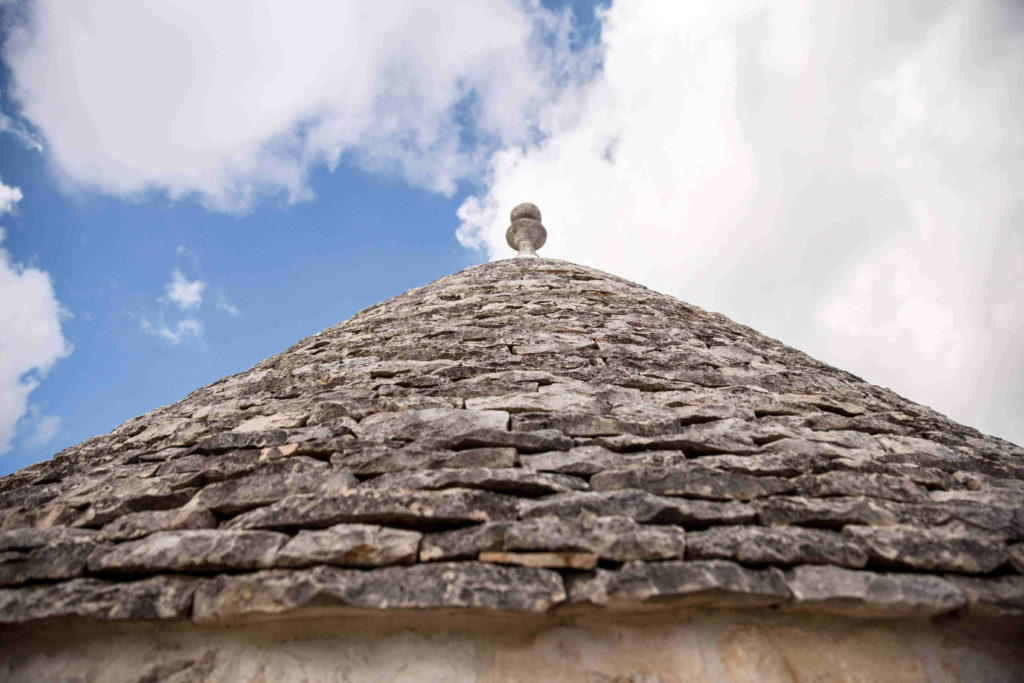
Trullo among history, mastery and peasant tradition
About its origin we have some thesis to compare, aware of the architectural evolution that comes from the circular structure tholos that means “dome” in Greek. Besides we know about the Byzantine domination that dates from the XI-XII century in the Valle d’Itria: Basilian monks, particularly Greeks and Byzantines, they were considered bearer of significant technical knowledge.
Moreover, the most remote paper reference dates back to a collection of documents from the duchy of Greta in 1067; the oldest existing trullo is located in the district of Marziolla in Locorotondo (Bari), and it was built in 1559 as reported on the lintel of the entrance door.
By now we have clarified our reference to the trullo, or in a historically more faithful description “casella” that in the local dialect is Casedda.
A crucial role is represented by the “casellaro”, which in the past centuries was the farmer – often helped by a relative or an apprentice with the construction of a shelter or a service room – with great self-taught skills.
The “arched wall structure” has played a decisive role in the achieving of a permanent home by allowing the easy opening of the trullo as a bigger space: this has been the last stage of a long evolutionary process.
About the architectural structure there are many steps to be performed.
Once you have found a resistant ground for the foundations, the first step is the construction of the base – part of the building that serves as base of the dome with the task of containing the thrusts, although slight, created by the mass of the wall made by layers of stones to be lifted from the ground.
The second step is the vault. We will place horizontal rings with the stone of Cannela and by raising them we will see how the diameter decreases until the closing of the vault with the so-called stone of serraglia.
Then is the turn of the covering surface made by chiancarelle limestone stones that made the dome waterproof, placed in circular rows sloping to allow the proper down flow of the rainwater.
Moreover they will be placed filling flakes to separate the chiancarelle from the internal stone of Cannela.
The last step is about the pinnacle that is an ornament placed at the top of the roof; it is made by the còcla a round sphere raised by the conical element called “cannarìle”.
“The architecture of a trullo is above all a lesson of sobriety, proportion, essentiality and coherence.” Pietro Massimo Fumarola